



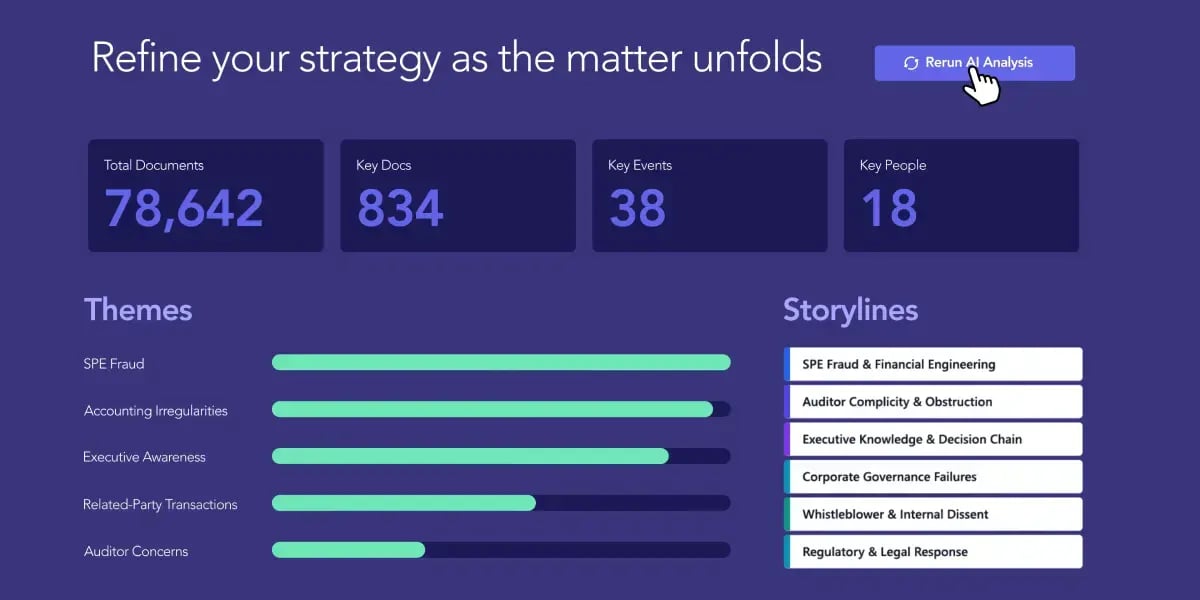
 How AI can help legal teams understand the matter earlier, develop case strategy sooner, and refine it as new facts emerge.
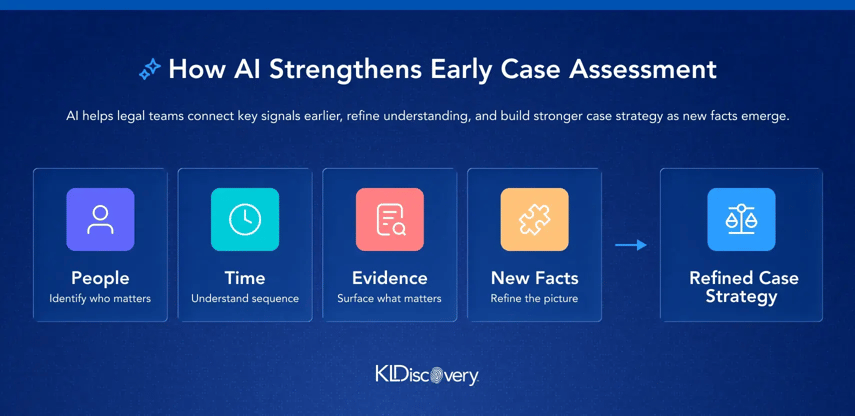
AI improves early case assessment by helping legal teams find the pieces that shape case strategy sooner: the people involved, the sequence of events, the evidence that matters, and the new facts that change the story. With that earlier view, teams have more time to refine their approach as the case develops.
That is the thinking behind KLDiscovery's Nebula AI Case Explorer™. It is built to help legal teams explore matter data earlier, identify the signals that shape strategy, and revisit the analysis as new facts emerge.
You started reading the room. Who is talking? Who has gone quiet? Who looks distracted? Who seems frustrated? Who looks engaged? You make a judgment.
Then the context changes. Someone adds a detail you didn't know, and you instantly change how you read the room.
This is how our brains work. We start with what we can see and hear, then adjust as more context comes in.
Legal teams do the same thing at the beginning of a matter.
The documents are collected. The names, dates, and issues may be visible. But the story is still forming. Case strategy depends on knowing which details matter, how they connect, and what changes when new information appears.
That is where early case assessment becomes critical.
Early case assessment is about helping legal teams understand the matter earlier, develop case strategy sooner, and refine it as new facts emerge.
There is pressure to assess risk, identify key issues, prioritize review, prepare for interviews or depositions, and advise the client. But the facts are still incomplete. The story is still taking shape.
The documents are there, but the story, strategy, and risk profile are still taking shape.
Which people matter most?
What happened first?
Which documents change the analysis?
What new facts alter the team’s assumptions?
These questions do not always have immediate answers. They develop as the team moves through the data and begins to see patterns. Early case assessment helps legal teams move from raw information to a working understanding of the matter.
That working understanding becomes the foundation for case strategy.
But that understanding does not appear all at once.
It usually begins with signals inside the data. Some are obvious. Others become important only after the team sees how they connect. In early case assessment, those signals often fall into four areas: people, time, evidence, and new facts.
Each one can influence how the team understands the matter and how case strategy begins to take shape.
Every matter has names, but not every name carries the same weight.
Some names appear often because of a person’s role. Others become important because they keep showing up near the decisions, conversations, or issues the legal team needs to understand.
Early in a matter, legal teams need to understand more than who appears in the documents. They need to understand who may be central to the story.
That includes questions such as:
Who is involved in the key communications?
Who connects different teams, issues, or events?
Who appears when the matter begins to shift?
Who should the legal team prioritize for review, interviews, or further analysis?
People help give shape to the matter. They also help legal teams decide where to look next.
Time helps legal teams understand how facts developed.
A document can mean one thing on Monday and something very different once the team understands what happened on Friday. Who knew what, when they knew it, and what they did next can change the way a legal team reads the entire record.
It helps legal teams see whether an issue appeared suddenly, developed over time, or changed after a key decision.
Early case assessment becomes more valuable when teams can begin to see the sequence sooner.
The goal is to understand how events developed and how timing may affect case strategy.
Not all documents are equal.
Most documents help fill in the background. A smaller set starts to explain the matter: the people involved, the issues in dispute, the timing, and the facts that could shift the team’s strategy.
Strong evidence can focus the questions the team asks. It can confirm a working theory, weaken an assumption, or reveal a new issue that deserves attention.
When legal teams can identify important evidence earlier, they have more time to assess risk, prepare strategy, and focus their review on what matters most.
New facts can change the way earlier facts are understood.
A deposition introduces a person who had not been prioritized.
A production from another party changes the timeline.
Review feedback shows that an early case theory was incomplete.
A regulator asks a question that the team did not expect.
In each case, the matter changes.
That is why case understanding cannot be static. A legal team may start with one view of the facts and refine it as new people, evidence, and issues emerge.
A case is understood in passes. The first pass provides orientation. The next pass leads to sharper questions. Another pass may change the strategy. Another may reveal what the team missed.
Every new fact has the potential to change what earlier facts mean.
Case strategy is not built in a single moment.
It develops as legal teams move through the data, evaluate new information, and revisit earlier assumptions. The strategy at the beginning of a matter may be directionally useful, but it is rarely final.
That is because legal teams make decisions based on what they know at a point in time. As that knowledge changes, strategy should change with it.
This is an important distinction for legal AI.
The future of legal AI should not be limited to faster answers or static summaries. Legal teams need tools that help them revisit the data with better context, better questions, and a more informed understanding of the matter.
The most valuable insight is not always the first one. Sometimes it comes after the team has seen the matter from another angle.
AI can play an important role in early case assessment by helping legal teams identify patterns, connect information, and return to the data as the matter develops.
That means helping teams explore people, timelines, evidence, and new facts in a way that supports legal judgment.
AI is most useful when it helps lawyers see the matter more clearly earlier, develop case strategy sooner, and refine that strategy as new facts emerge.
In that sense, AI should support the way legal teams already think. It should help them ask better questions, test assumptions, and understand how the story changes as the matter unfolds.
AI Case Explorer was built around this idea and is available as part of KLDiscovery’s Nebula platform.
AI Case Explorer helps legal teams work through matter data in a more focused way, from identifying important people and timelines to evaluating evidence and revisiting the analysis when new facts emerge.
That matters because legal teams do not need a single fixed view of the case. They need a way to keep building understanding as the matter develops.
Early case assessment should help teams move from documents to direction. From facts to strategy. From first impressions to a more refined understanding of the matter.
Cases change. New evidence appears. Assumptions evolve. Strategy improves as understanding improves.
The future of early case assessment is helping legal teams understand sooner, learn faster, and refine case strategy as the story becomes clearer.
Learn how AI Case Explorer helps legal teams understand matters earlier, develop case strategy sooner, and refine strategy as new facts emerge.