



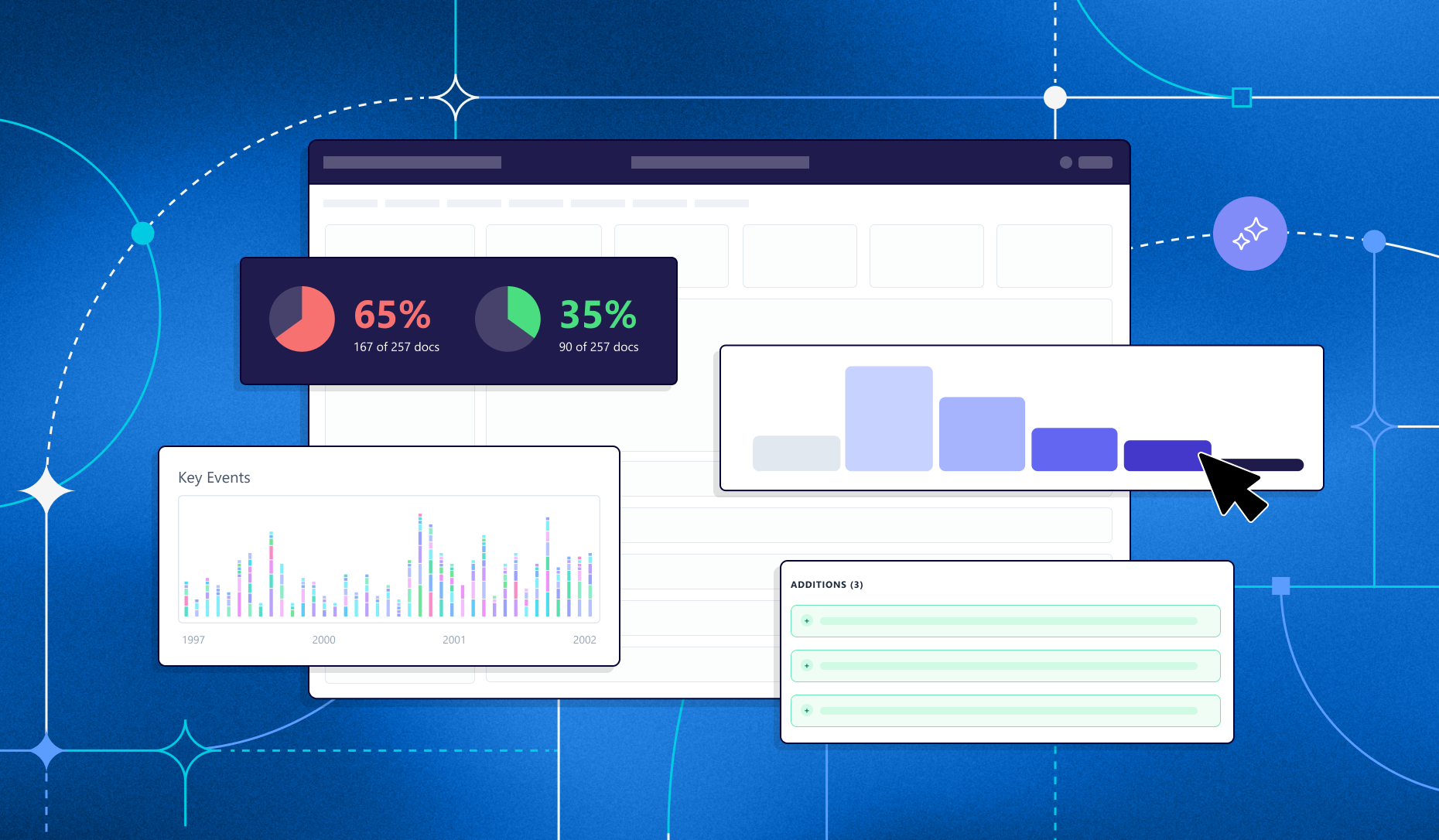

Many, but not all, product teams collect feedback after a release. We collect it before we commit any engineering time and continue to collect it throughout the process to ensure the legal teams and attorneys we work with are getting the most impactful solutions for their matters. Early ideas become AI-generated prototypes. Then, we get them in front of clients and internal teams for feedback before a single requirement is finalized.
This is especially important in eDiscovery, where deadlines set by courts, opposing counsel, and case timelines are difficult to predict and control. A product that looks good in a demo but adds unnecessary steps to their workflow costs clients time that they don’t have. Including clients early and throughout the process means that we catch potential issues before they’re released, not after they submit a support ticket.
Our internal service teams, from advisory to eDiscovery technologists, also have deep workflow expertise to help validate our design decisions. They handle the same kind of eDiscovery work that many of our clients do so they can bring the right concerns, challenges, and goals when assessing an early prototype. If an internal user questions a workflow or hesitates over an interaction, that response gets treated as a signal that needs to be addressed.
With AI-assisted prototyping, an idea goes from concept to something interactive within hours, not weeks, allowing for faster development of a solution our clients can use. We start with needs we frequently hear from clients. For example, understanding the data in their matters faster, the starting point for Nebula AI Case Explorer. Or achieving greater efficiency and cost control in their review workflows, the basis for our forthcoming AI review solution, Agent Review. The prototypes we built to address these would have taken weeks, if not months, with traditional prototyping approaches. But with AI-assisted prototyping, the input from feedback sessions goes directly back into the next version of the prototype. Continued iteration of these prototypes happens within minutes, allowing us to edit and tweak design while simultaneously refining with our engineering team.
Our prototyping loop has four steps:
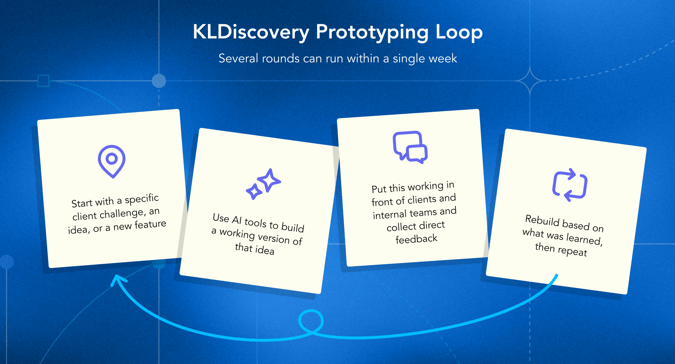
A prototyping loop can run several times within a single week, quickly providing more rounds of valuable feedback that contribute to a more impactful solution. This kind of approach, coupled with AI, shortens the time between an idea shared with a client and a variation of a prototype, saving up to 200 hours a year of work.
Throughout our organization, AI prototyping is not only encouraged, but also expected, to efficiently deliver the most effective solutions. Our Chief Product Officer, Julian Merschen, prototyped the very first concept of Nebula AI Case Explorer, reinforcing the notion that anyone on the team could and should use AI tools to share ideas, and that it’s not a specialized skill locked inside the UX team. Our product, design, data science, and engineering teams all work together to iterate and solve problems, frequently building prototypes and sharing them for feedback
If our own teams won't use the products we’ve built, we have no business asking clients to. Trying recipes from our test kitchen means our staff runs our products against real internal work before it reaches a client. This more effectively surfaces friction and potential pain points that otherwise could be missed. A workflow that takes an extra click, a report that's hard to read, or a step that only makes sense if you already know the system are a few examples of discoveries that are more easily made by utilizing interactive AI prototypes. And it doesn’t stop once the product is released. We constantly go through the iteration loop to improve the products based on the ongoing feedback from our clients and internal teams.
Two things to look for when you evaluate a technology provider and their design process. First, ask how quickly they can put a rough prototype in front of you after your first conversation. A partner willing to test ideas within a week, rather than showing you a finished product months later, is one that catches issues before it becomes your problem in the middle of a live matter. Second, ask who inside the organization is allowed to build and test ideas, and if they can use AI to do it. When prototyping isn't limited to one team, the people who understand eDiscovery workflows firsthand get a hand in shaping the product you'll eventually rely on.
Our product design and development loop will keep evolving as the AI tools we use for prototypes and builds continue improving. The gap between a rough idea and real feedback from you will get smaller, and that means the solutions we bring to your eDiscovery challenges get sharper and arrive faster.
When you evaluate a technology provider, ask how they test new tools and approaches. A partner that continually refines its process is a provider that keeps refining what it builds for you.
Curious what that could look like for your team? Talk to us about which AI solutions fit your eDiscovery challenges best.
No. AI shortens the time between an idea and something you can react to. Our product, design, data science, and engineering teams still decide what the experience should be, interpret your feedback, and decide what changes. AI removes the wait, not the judgment.